
Stephen is a co-founder of OPEN Impact Real Estate. He has 20 years of commercial real estate experience dedicated to serving nonprofits. Stephen and the OPEN team have completed over ten million square feet of transactions for nonprofit clients, all while ensuring that the real estate strategy is always driven by mission and operational/programmatic goals. Stephen was nominated for the Real Estate Board of New York’s Most Ingenious Deal of the Year and recognized by City and State’s as a Nonprofit Trailblazer. A creative problem-solver, he specializes in producing out-of-the box real estate solutions for his clients.
Tell me about OPEN Impact Real Estate and who it serves.
OPEN is a mission-driven commercial real estate firm that works across the country, helping nonprofits, schools, foundations, cultural institutions and corporations make smart, sustainable real estate decisions. Through our national partnership with JLL, we combine the agility of a boutique firm with the research, technology and reach of a global platform. The nonprofit practice within OPEN includes human service organization, foundations, charter and private schools, medical organizations and cultural and higher education institutions.

The OPEN Impact Real Estate team
At OPEN, your team works extensively with nonprofit organizations. Why is real estate different for nonprofits compared to their for-profit counterparts?
For nonprofits, real estate is often inseparable from mission. Nonprofits use space to serve — to educate, feed, shelter or heal. Their funding models are different than corporations, and they can access tools like tax-exempt financing, public grants and creative lease structures that shift risk to the landlord. They also require buy-in from boards and funders, which adds complexity. Since funding is often finite, If something goes wrong, it can threaten the survival of the organization. That’s why structuring deals correctly from day one is critical.
What are some of the ways OPEN Impact Real Estate helps nonprofit organizations looking for new space?
OPEN supports nonprofits from strategy through execution. That starts with understanding their programmatic needs, financial model and future plans. Then we help them define their space needs, assess locations through deep demographic and location analytics, and build alignment with boards and funders. From there, we run competitive processes, structure creative deals, and manage negotiations to maximize value and minimize risk.
Whether it’s a lease, purchase, sale or condo structure, we stay involved through closing — and often beyond.
What is most important to nonprofits looking for new space?
Nonprofits need predictable outcomes because their budgets are often board-approved, publicly funded, or tied to donor capital campaigns. They also want space that’s mission-aligned — it’s not just where people work, it’s where programs happen, donors gather and impact is delivered.
Nonprofits need creative deal structures that protect them from real estate risk and maximize every dollar. They want partners who understand how to leverage their tax-exempt status, apply for public funds and structure leases that avoid cost overruns and delays.
What mistakes should nonprofits avoid when beginning their search for a new location or property?
- Acting without a process. Too often, nonprofit organizations chase a “special real estate opportunity” without testing the market or comparing options. That kills leverage and results in unnecessary starts and stops.
- Trying to go it alone. Commercial real estate is high-stakes and complex. Nonprofits need expert representation from a firm that specializes in representing tax exempt organizations.
- Taking on real estate risk. Open-ended budgets and construction exposure can be a pitfall for a nonprofit. Nonprofits should be strategic and ensure they can afford the all-in cost. Board’s need cost certainty—define the cost upfront and transfer the risk onto the developer; they are in the business of taking on real estate risk, not nonprofits.
- Misusing board members. Don’t rely on a board member as your attorney or broker — even if they’re willing. It’s a conflict and it creates an inverse hierarchy that should not exist in a client relationship.
- Assuming free means free. Donated space often comes with hidden costs like OpEx, deferred maintenance and renovation expense that often exceeds the cost of acquiring or leasing a space that meets an organization’s specific needs from the start.
OPEN has represented numerous schools and educational organizations. What challenges do these groups face when looking for a new location?
Enrollment drives revenue. It’s important to understand the demand associated with a location to assess the enrollment that drives a school’s business model. From serving underserved populations that qualify for free lunch, to serving students with special needs, to the fiercely competitive private school landscapes, location and quality matter.
Schools also need purpose-built space — not every office building can accommodate a gym, cafeteria, or outdoor play area. Special education schools or those serving low-income populations often require even more nuanced planning to solve transit logistics and align with funding streams to achieve long-term sustainability. We help our school clients with demand analysis, location modeling and tailored site selection to meet their mission and financial goals.
What are key factors that Boards should know before embarking on a real estate project?
Boards should understand this isn’t just about real estate — it’s a capital investment tied to mission delivery.
Key considerations should include:
- Creating a real estate task force or Board champion early.
- Build in Board approval milestones: Approve the strategy, then the property, then the final contract. Bringing the Board in throughout the process builds consensus and unity.
- Provide the Board with a fully vetted recommendation. Provide support for decision making that is bolstered by subject matter experts related to design, construction, search, and deal structuring.
- Ensure there is full financial clarity before executing a lease or launching a capital campaign.
OPEN guides boards through each stage to build consensus and support efficient, management led Board approved decision making.
OPEN has come up with some pretty creative lease structures for its nonprofit clients. Tell us about some of them.
Yes. That is one of the benefits of working with a team that understands how to create leverage for the nonprofit and maximize flexibility and risk transference.
Recently, OPEN worked with a school that owned its building but needed to monetize it to create an endowment. We structured a sale with a rent-free leaseback so they could stay until their new turnkey leased space was built. The new lease had a delayed rent commencement tied to certificate of occupancy, phased-in rent, and penalty clauses if the landlord delivered late.
That level of coordination between sale and lease — while minimizing tax exposure and construction risk — is critical for success.
OPEN recently created a partnership with JLL. Tell us about that and how it benefits your clients.
Through our national WBE partnership with JLL, our clients get the best of both worlds: the mission-aligned, partner-led service of a boutique firm and the resources, research, and technology of a global platform. That includes access to tools like digital portfolio platforms, dashboarding, AI enabled analytics, best-in-class financial modeling, location and demographic analysis and scores of other leading age tools that provide our clients with the data, efficiency and optimization resources needed to make the most informed real estate decisions. We work seamlessly with JLL’s local market experts, project managers, and consultants to deliver outcomes at the level of what Fortune 500 firms expect —tailored for the nonprofit sector.

(L to R) Peter Riguardi, Michael Colacino, Lindsay Ornstein, Stephen Powers and Steve Schlegel. Credit: Nick Coleman
OPEN is a MWBE. What does that mean?
OPEN Impact Real Estate is a certified Minority and Women Owned Business Enterprise (WMBE). But more importantly, our business is built on excellence — first.
Our clients choose us for our expertise, and the certification ensures that supplier diversity goals are achieved with confidence. We bring diverse lived experiences to the table — people from social work, sustainability, affordable housing and education — and that helps us better serve and connect with clients who have complex, community-focused, missions and goals.

Stephen Powers and Lindsay Ornstein, co-founders of OPEN Impact Real Estate
Tell us about OPEN’s co-founder, Lindsay Ornstein. What is her focus and how do you two complement each other?
Lindsay and I built OPEN together out of a shared commitment to doing what’s right for clients, every time. She leads much of our office and corporate client work, representing major financial institutions, Fortune 500 and professional services companies across the region, in addition to the nonprofit and charter school work OPEN is renowned for. Lindsay is known for her relentless focus on creating positive outcomes, for her grace under pressure, and for building a culture of excellence and respect. She’s also a leader in ensuring our team thrives — with real flexibility, balance and purpose — while holding a high bar for responsiveness and performance.
OPEN donates a portion of its earned fees to charity. Why?
Because we believe in walking the walk and being part of our clients’ success in serving the community. Giving back is part of how we stay grounded in mission; . it’s core to how we operate.
Over the years, we have donated millions to nonprofit organizations — including ones chosen by our corporate clients.
OPEN is one of the few commercial real estate firms that uses a salary/bonus model. How does that help you better serve your clients?
We’re not commission-based, which flips the traditional brokerage model on its head. That means our people don’t compete — they collaborate. It also allows us to recruit and retain talent from a much broader pool, including professionals who otherwise would be financially precluded from working in brokerage given the erratic compensation of a commission-based model. Ultimately, it results in a more diverse, more committed, and a more aligned team — and better service and outcomes for our clients.
Recently, there has been a lot of pushback on the practice of supporting or mandating ‘diversity and inclusion.’ Why is a diverse team important in your business?
Because diverse teams perform better — full stop. It’s not about politics; it’s about business. If you want the best team who provide clients with the best results, you need a big talent pool with diverse experience and viewpoints. Our team includes people who’ve worked in social work, education, housing, workplace strategy and law, in addition to being 50% women and over 1/3 people of color. That range of experience and collection of viewpoints helps us serve our clients with insight, empathy, and strategic depth.
What has been the effect of the constant, yet inconsistent, threats of funding cuts to nonprofits?
It’s forced the sector to get leaner, more collaborative, and more strategic. We’re seeing nonprofits partner more, look at co-location models, leverage hybrid work policies, and rethink how their space supports programs and financial sustainability. It’s made organizations stronger and more resilient — but it’s also made planning harder. Our job is to help them build flexibility into their real estate holdings, so they’re better prepared for uncertainty.
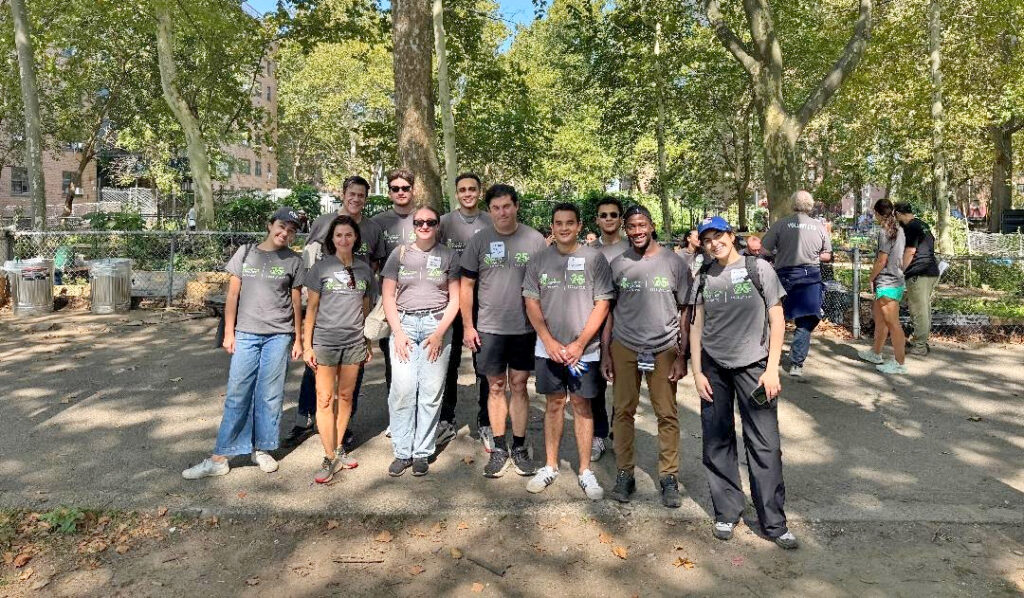
The OPEN Impact Real Estate team at a recent volunteer outing.
What’s next for OPEN?
We’re scaling our impact. Through our national partnership with JLL, OPEN is expanding into more markets where nonprofits, schools, and mission-driven organizations need specialized real estate guidance — not just brokerage, but strategic partnership. That means more work in cities like D.C., Boston, L.A., and Chicago, and more collaborations with foundations, cultural institutions and public agencies.
We’re also doubling down on innovation. That includes leveraging data and location analytics, and AI to help our clients to plan for the future — not just today’s needs, but where their communities and stakeholders will be in 5–10 years. We’re continuing to push creative structures that reduce risk, unlock capital and make real estate work smarter for nonprofits.
And internally, we’re building the most mission-aligned, inclusive, and high-performing team in the industry — backed by our salary/bonus model, our WMBE certification, our advanced technology, and a culture that prioritizes excellence, purpose and people.